


Aswin Yogesh R is a skilled UX professional. He received his M.Des in visual communication design from IDC (IIT Bombay) in 2017. Prior to that, he received his B. Tech. from Anna University.


Source: India, IDC IIT Bombay
Date: 2015-2017
Medium: Photograph
Credits: IDC
Aswin Yogesh R is a skilled UX professional. He received his M.Des in visual communication design from IDC (IIT Bombay) in 2017. Prior to that, he received his B. Tech. from Anna University.
Related Links:
https://uk.linkedin.com/in/aswinyogesh?original_referer=https%3A%2F%2Fwww.google.com%2F
Reference Links:
http://ddsidc.com/2017/portfolio/aswin-yogesh/

A monotonous environment while driving on long highways can lead to a dangerous state of drowsiness in the driver. The previous advanced design project (ADP) of Amini et al. developed the concept of a driving assistant system that uses gamification features to break the monotony of the driving task. This work picks up this concept and develops a software prototype of an interface to perform Wizard of Oz-experiments in the driving simulator of the institute for ergonomics (IAD) at the Technical University Darmstadt. The development processes are due to the guidelines of the human-centred design process. The context of use for the prototype must be seen from the perspective of the driver as well as from the perspective of the experimenter. The driver is in a monotonous driving environment and can get input via head-up display (HUD), liquid crystal display (LCD), or audio output. The experimenter can monitor data about the current driving behaviour given by the simulator software. In addition, the experimenter uses the prototype on a laptop. The requirements for the development are derived from ISO 9241-110. The developed prototype is an interface between driver and assistant, as well as an interface between experimenter and assistant system. A user of the prototype can control the three output channels with the software prototype. The user sees the content of the HUD and LCD and has a control panel with buttons that enable him to handle his task. In contrast to this, the driver can only see the parts of the interface shown via the HUD and the LCD. The screen content of the wizard interface is shared with the software screenleap and teamviewer on a smartphone in front of the windscreen, which represents the HUD, and on a tablet, which represents the LCD on the middle console of the car. Therefore, it is possible to show the corresponding parts of the interface to the driver.
It is possible for the driver to interact with the assistant system by voice. A start procedure, a quiz, and three driving games that motivate the driver to show better driving behaviour are the main features of the prototype. The games challenge the driver to hold the current speed, the current distance to the vehicle in front, or the exact position in the middle of the driving lane for 60 seconds. The task of the experimenter is to rate the behaviour of the driver during the games and transfer this input to the assistant system. Buttons to rate the behaviour and create a score are included in the interface of the experimenter. Depending on the score, the driver receives feedback about his current performance from the HUD and afterwards about his performance over the complete duration of the game. Furthermore, the experimenter can handle scenarios that pause the game, e.g., lane changes or dangerous situations like emergency stops. Next to the driving games, a quiz is implemented in the prototype. The quiz and the starting procedure are created as an oral dialogue between the driver and the assistant system. To trigger the corresponding audio output, the experimenter has different buttons that suit the current situation. The usability of the prototype for the experimenter is evaluated in this paper. Afterwards, small changes will be considered to improve usability. The prototype developed allows for the performance of Wizard of Oz experiments in the context of the IAD driving simulator. Only these experiments can show if the concept of an assistant system that uses the described gamification features is suitable for a driving scenario with other road users and if such an assistant system can reduce the monotony of the driver.

What can a cashless society do for microcredit? High operation costs are cited as a reason for the high interest rates on microloans. This leads to the microloans being among the most expensive loans in the world, while the repayment rates are unbelievably high, above 96%. This is a loan officer at work in a Grameen local unit.
What has changed in the way we live, and how are the big powers, both within the state and external, influencing our lives?
The film will explore how we have broken away from the traditions of sustainable living and how the development the state undertakes in the name of sustainability, if not helping, is sometimes doing more damage to man, the environment, and our future.
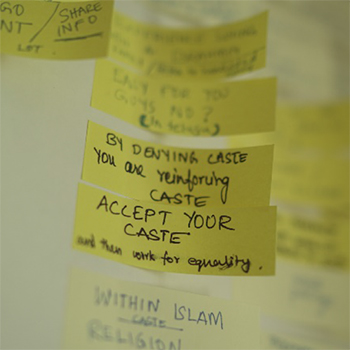
Meritocracy is a social system in which people hold positions exclusively based on their abilities. But India, as a democracy, undertakes several measures to reduce the inequality caused by historical prejudices by showing positive discrimination like caste-based reservations.
The Indian Institutes of Technology were established after Independence to create trained technical personnel of international standards for the nation. In order to establish "merit" as the only criterion for admission into these institutes, they were originally exempt from the policy of reservations. Extant structural inequalities ensured that only the "already privileged" could find their way into these spaces of "merit". As a result, these institutions have until recently been almost exclusively populated by the upper castes, who, through the instruments of merit, were able to transform their caste capital into modern, "caste-less" capital.
All this changed with the introduction of a 22.5% reservation for Scheduled Castes and Scheduled Tribes in 1973 and 27% for Other Backward Castes in 2006. This has transformed the IITs into heterogeneous, complex, and often volatile, politically charged spaces.
The encounter of the ideologies of meritocracy and caste in the spaces of IIT Bombay throws up interesting, difficult questions. This film is an attempt to identify, articulate, and interrogate the complexity caste brings to the IIT Bombay campus by exploring the stories of people who are part of it.