Home / Alumni / Profile / Detail

Sanjay Nair | B.E.(Mech Engg) | Mdes PD 08-10


Related Images


Source: India,   IDC

Date: 2008-2010 

Medium: Photograph

Credits: IDC


Detailed Description

Sanjay Nair studied at IDC (IIT Bombay) and completed his M.Des in Product Design in 2010. He has 10+ years of experience in the design profession. Currently, he is working as a Senior User Experience Designer at Amazon (2020–Present). His previous work experience includes: Engineer at Larsen and Turbo Limited (2005-2008), Lead Designer at Honeywell Technology Solutions Ltd. (2010-2017), and Creative UX Director at Mooncraft Innovation Lab (2017-2020).


Projects

Jugaad - a Study in Indian Vernacular Design

There are situations when solving a problem may not be easy or possible by conventional means or in a formal way. It may be due to a lack of resources or due to a time constraint. At such times, overlooking the problem or waiting for the perfect solution to arrive may not be the answer. It has to be done by any means, calling for out-of-the-box thinking and going beyond the existing way of doing things. These kinds of situations happen more often in our country. The way we solve such problems is known as "Jugaad". Jugaad is essentially a colloquial word in Hindi, meaning an eclectic assembly that somehow works. What does Jugaad exactly mean? How are jugaad and design related? Is Jugaad an innovation? Is Jugaad a healthy culture? Can jugaad be classified into different types? Can there be guidelines for different types of Jugaad? The objective of my study was to find an answer to these questions.


Summer Internship at Silpa- Sadan

Silpa Sadana (SS)is a crafts institute located 3 km away from Santiniketan in Sriniketan(SN). The object of Sriniketan is to bring back life in its completeness to the villages, making them self-reliant and self-respectful, acquainted with the cultural tradition of their own country, and competent to make efficient use of modern resources for the improvement of their physical, intellectual, and economic condition. Tagore, Rabindranath, 1928. Sriniketan today comprises the following departments within its broad ambit: Palli Siksha Bhavana (Agricultural Science Institute) Palli Sangathana Vibhaga (Rural Extension Centre) Department of Social Work Palli Charcha Kendra (i) Silpa Sadan. Silpa Sadana commenced work in 1922. It is aimed at revitalising decaying crafts as well as innovating craft-related activities to introduce them to local artisans. It has, broadly, a training aspect, a production arm (marketing) aspect, and a development aspect. In its training aspect, SS (Crafts Centre) offers a 3-year diploma course in nine different specialisations to about 80 regular students. Most of the products of the SS are sold at its Sales Emporium in SN and through counters put up at the Pous Mela, Magh Mela, and the Rathindra Shilpa Mela held once a year. Predictably, the SS has become the provider of bric-a-brac to Visva Bharti, in terms of its convocation scarves, uniforms, dress materials, parchments for certificates, files, bookbinding materials, and some furniture, as per the needs of the university. Apart from this, four traditional village weavers, enlisted from nearby villages, produce handloom fabrics on a piece-rated basis upon receiving raw materials from SS.


Luggage Design for a Middle Class Family

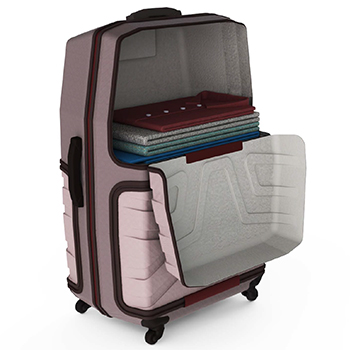
Small families travelling longer distances by train generally use multiple luggage of a smaller size (less than 22"). This has advantages like ease of handling and separate space for each individual. Large-sized luggage (between 28" and 32") is mostly used for air travel due to restrictions on the total weight of individual luggage and the number of bags an individual can carry. Family trips generally tend to be of short duration (4–7 days) due to the fact that the packed items are not completely removed from the luggage during the trip. Luggage is accessed intermittently during this period whenever something needs to be taken out. Organizing and accessing items becomes difficult when many members of a family use common large luggage. Business travellers hopping from one place to the other face a similar situation. They literally have to "Live Out of the Box". Many innovations are taking place in luggage design with respect to the materials, colours, textures, and wheels. But even today, luggage continues to have one or two major compartments into which we pack our belongings. This project aims at designing luggage for a small family of 3–4 members travelling by air (for 4–7 days), which will allow individual members to organise and access their luggage contents easily during travel.


Playing kit for Visually Impaired children

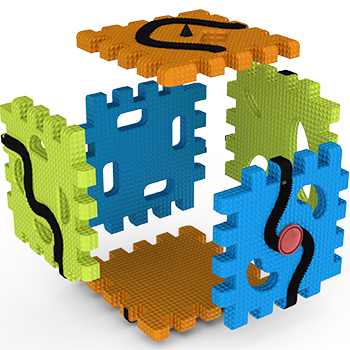
Try imagining the world by closing your eyes as if you have never seen it. One's perception of the world is drastically altered when one interprets it through the other senses. Vision is an integral part of our learning process and helps in perceiving the world around us. Children with an absence or lack of vision need motivation to explore the world around them. It becomes important for them to engage their other senses more effectively for learning. Many things that sighted children learn by playing or observing have to be taught to visually impaired children. My project involved understanding the world of visually impaired children by looking at existing systems that encouraged exploratory behaviour, researching early childhood education, and interacting with individuals linked to the blind community. The research led to prototypes aimed at engaging visually impaired children in play. The objective of the design is to create a play kit that gives them the opportunity to learn through play and exploration while building their various physical, cognitive, and social skills.