Stroke, also known as cerebrovascular accident (CVA), cerebrovascular insult (CVI), or brain attack, is when poor blood flow to the brain results in cell death. Stroke survivors are often left with residual effects ranging from physical and emotional to cognitive limitations. The severity of these conditions can be minimized if proper rehabilitation is followed from the early stages of diagnosis. More often people suffer from hemiparesis, weakness of the entire left or right side of the body due to stroke. This limits their fine motor skills in terms of muscle strength, range of motion and coordination. Fine motor control disorders can dramatically reduce the ability of a person to perform daily activities like eating, dressing, taking bath, grooming and even returning to productive work. [Stroke therapy through motion-based games]
The rehabilitation program is extensive and often requires regular practice. The existing facilities for motor skills rehabilitation are not accessible to a large part of the community due to inadequate healthcare systems and poor affordability. People tend to discontinue the therapy soon after hospital care due to lack of motivation and the expenses involved. The absence of facilities to continue rehabilitation outside a hospital environment is also a major factor in forcing patients to drop out of rehabilitation therapy.
This project titled Re - A platform for motor skills rehabilitation through games proposes a platform for motor skills rehabilitation through games. The objective of gamifying the rehabilitation routine is to keep the participants engaged and motivated to continue the routine and benefit from it. The platform uses a smartphone as a controller and a computer to run the game.
This enables accessibility and affordability to the participants since they can assemble the platform without investing and/or acquiring any dedicated devices.
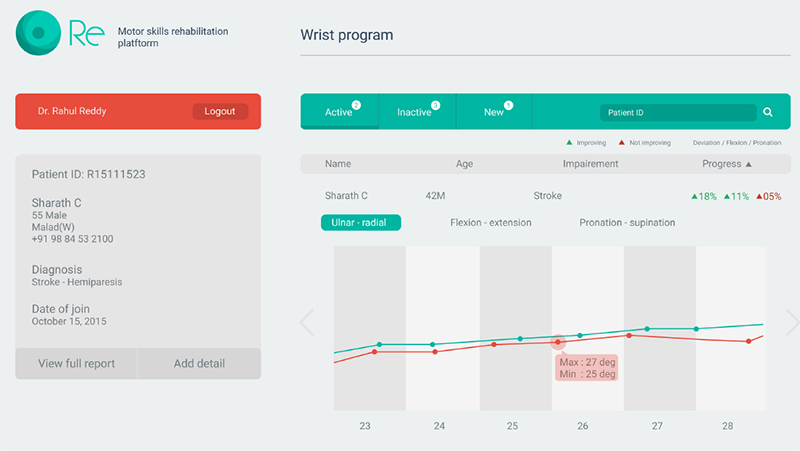
The game adjusts itself to the participant’s skills and records various data such as the length of each gameplay session, frequency of sessions throughout a week and range of motion. This data is made available to the therapist through a web portal, where the participant’s progress can be reviewed with greater accuracy and in a systematic manner.
Case Study Download:
• Re - A platform for motor skills rehabilitation through games......
• Re - A platform for motor skills rehabilitation through games_Report......