Design Case study
Cutlery Explorations using Coconut Shell
Useful intervention of technology in making cutlery products
by

Introduction

Coconut palm tree is one of the most valuable natural resources. It is called ‘Kalpavriksha’ meaning wish-fulfilling divine tree. It is because almost every part of the tree is used in some or the other way. Coconut shell has always been used as a cooking fuel and to make small multiple utility bowls or serving spoons with simple bamboo joinery. Coconut Shell has remarkable properties such as strength, hardness, durability and resistance to fungal attack. These properties can be used to make products of different varieties and it has a huge scope in the market. The project aims to change the perception of coconut shell to something that could be used creatively and aesthetically as a lifestyle accessory espousing crafts, craftsmanship and related livelihood.
An in-depth study of coconut shell such as its anatomy, structure, composition, patterns and texture was done. Not only this, the variety of cuts to produce different forms was also looked into. Understanding appropriate and relevant tools to work with shell was one of the crucial parts of the project. This led to discovering of new tools that could be used. An example of one such tool is the ordinary wire brush that could be mounted in the drilling machine to clean the insides of the shell. Prior to this, cleaning the insides of shell was done manually which took more effort and was time consuming.
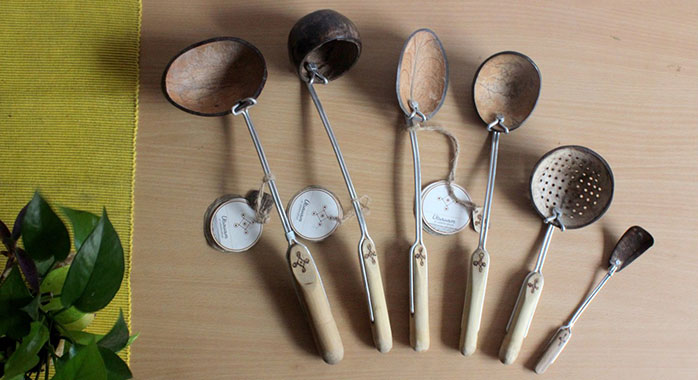
After an initial phase of exploring possible product ranges, cutlery (ladles and spoons) was chosen for further exploration. Study of available cutlery, its anatomy, proportions and usage was done. Since the shell is hard, quick and dirty mock-ups were done through soft prototyping. In this, plastic balls were used in place of coconut shells. Similarly, other materials such as PVC pipes, styrene, soft aluminium etc. were also used. Joinery details to improve stability, strength and to enhance aesthetics of the product were tried out. Various mock-ups were made and the desired ones were selected to be developed with coconut shells. The process then focused on combining the shell with other materials such as bamboo, wood, steel, brass and aluminium for material exploration. The explorations fell into these categories:
1) Combing shell with natural materials such as wood, bamboo, cane etc.
2) Combining shell with industrial material such as steel, brass, aluminium etc.
3) Combining shell with both natural and industrial materials etc.
We went ahead with the third category because it was a new area where industry and craft could come together. Three materials -coconut shell, aluminium wires and bamboo were used. Jigs were designed for easy production and replication of different parts in less time. As part of the final deliverable, a range of a family of ladles was proposed. Branding and logo details were done to complement the product. ‘Utsavam’ which means celebration chosen as the name of the product range. This was to imbibe the celebratory nature of the product.
Case Study Download:
• Cutlery Explorations using Coconut Shell......