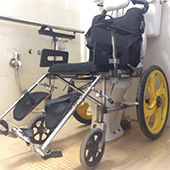
Design Case study
Designing of Wheelchair for Cerebral Palsy Patients
Sturdy, affordable and lightweight wheelchair
by

Introduction

Disabled children are of great concern to a family as well as to the society. When disability is discussed, particularly in children, about a quarter of chronic childhood problems are neurological in origin. Cerebral palsy (CP) is the leading cause of chronic disability in children, making them physically and mentally handicapped and socially aloof.
The worldwide incidence of CP is approximately 2 to 2.5 cases per 1000 live births. In India, it is estimated at around 3 cases per 1000 live births; however, being a developing country the actual figure may be much higher than probable figures. There are about 25 lakh CP children in India as per the last statistical information.
It is a symptom complex or syndrome condition rather than a single disease. It is an umbrella term encompassing a group of non- progressive, non-contagious condition that causes motor impairment syndrome characterized by abnormalities in movement, posture, and tone. In short, it is a group of symptoms occurring due to the involvement of musculature, sense organs (i.e. vision, hearing, speech, etc.), and the mind, including intelligence at variable extents. It can be caused by any of pre-natal, natal, and post-natal factors and the primary eventual pathology is any type of injury to the developing brain.
Due to the non-progressive nature of the lesion, historically it is considered as static encephalopathy and excludes all the progressive neurological disorders. No effective treatment for the underlying brain damage has been formulated to date.
Case Study Download:
• Designing of Wheelchair for Cerebral Palsy Patients......
• Designing of Wheelchair for Cerebral Palsy Patients_Report......
