Design Case study
Design for Blind People Accessing Public Buses
Designing a system helping blind people find their desired bus correctly
by

Introduction

Public transportation is the basic amenity that any city is supposed to have for travelling within and outside the city. That being the case, this amenity must be available to the residents irrespective of their social status, gender, physical condition, etc. It is also a basic right for every citizen to be able to navigate comfortably to places of work and so forth in the city of their residence.
Buses and trains are used by a great number of people on a daily basis. “Bus and rail networks are the lifeblood of Indian society and prime movers of the local economies” says Jamie Osborne, a Transit Planner and Accessibility Specialist with the San Francisco Municipal Transportation Agency after a travel through India (Osborne, 2007). A lot of work keeps happening in the domain of transportation to give this comfortable commute to the citizens in a country like India with such a large population. Year after year more people move to cities for opportunities and the cities have to battle with infrastructural maintenance nonetheless but we still need to buckle up to make public transportation accessible.
India has the largest blind population in the world of nearly 20 million. Around 1.5% of the population is blind. But the impairment does not restrict them from studying, having ambitions and raising a family. Sadly, many portions of the world have still not been completely made accessible. Their basic requirement is affected when the navigation is curbed. Many people prefer staying indoors than to get out there and battle everyday with transportation and infrastructure.
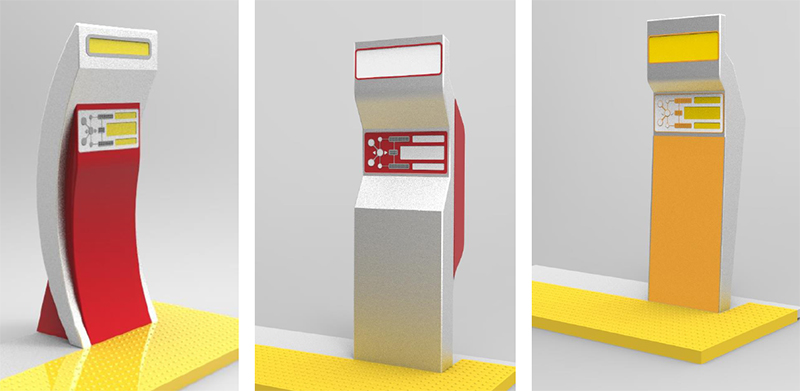
This entire project is an attempt to help the visually impaired people access public transportation with less difficulty and navigate to places of their requirement more efficiently. As part of this project, I spent the initial part of the project’s tenure in Darmstadt, Germany. This was an attempt to understand the cultural differences, infrastructural advancements, understand the attempts to provide solution and design a guiding system which would act as an assistant to the person using it whether visually impaired. For the project, the chosen mode of transportation is public bus since after looking at some other transportation means it seemed the bus system is pretty much the same in both Germany and India. Both countries have visions to make the countries barrier free by 2020 (Johari, 2017). Though one is a developed country and one is developing pretty fast, the visually impaired citizens did have their concerns about not being able to travel like their counterparts.
This Innovative Project Secures Patent Approval: A Major Milestone
We are delighted to announce the successful approval of a patent for this groundbreaking project. This significant achievement underscores the unique and innovative aspects of the student’s work, recognizing it as a valuable contribution to its respective field.
Case Study Download:
• Design for Blind People Accessing Public Buses_Report......