Design Case study
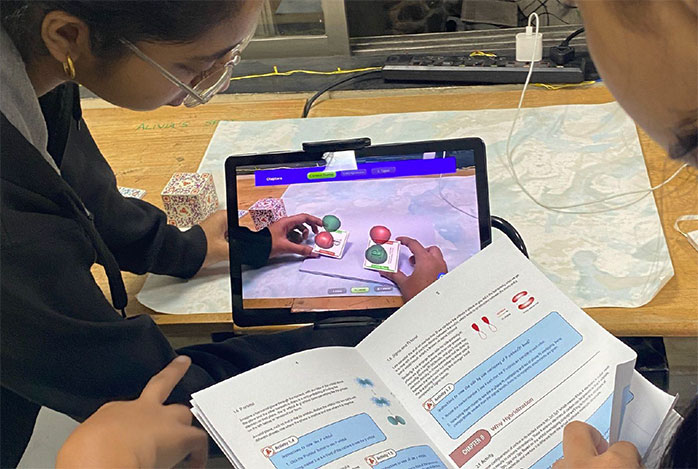
Augmented Reality for Understanding Hybridization in Organic Chemistry
Developing a prototype using innovative AR design and various marker-based interaction techniques
by

Links

References:
• Nakiboğlu, Canan. “Instructional Misconceptions Of Turkish Prospective Chemistry Teachers About Atomic Orbitals And Hybridization.” Chemistry Education Research and Practice 4 (2003): 171-188.
• Wu H. and Shah P., (2004), Exploring visuospatial thinking in chemistry learning, Sci. Educ.
• Al-Balushi, Sulaiman M., and Sheikha H. Al-Hajri. “Associating Animations with Concrete Models to Enhance Students' Comprehension of Different Visual Representations in Organic Chemistry.” Chem. Educ. Res. Pract. 15.1 (2014): 47–58. Web.
• Abdinejad, M., Talaie, B., Qorbani, H.S. et al(2021). Student Perceptions Using Augmented Reality and 3D Visualization Technologies in Chemistry Education. J Sci Educ Technol.
• L Ya Midak et al 2022 J. Phys.: Conf. Ser. 2288 012017
• Sarah E. Wegwerth, Jason S. Overby, Christopher J. Douglas, Julia E. Winter, Gianna J. Manchester, and Joseph EngalanJournal of Chemical Education 2021 98 (2)
• F. Cortes Rodriguez, L. Krapp, M. Dal Peraro, L. Abriata, Chimia 2022, 76, 145, DOI: 10.2533/chimia.2022.145.
• Mobile Marker-based Augmented Reality as an Intuitive Instruction Manual, HANNAH REUTERDAHL
• NCERT SChemistry Textbooks of class 11 and 12
• ORGANIC CHEMISTRY by Jonathan Clayden
Other Links:
• Useful resource e-links related to 'Interaction Design'
• Interaction Design at IDC IIT Bombay
Case Study Download:
• Augmented Reality for Understanding Hybridization in Organic Chemistry......